A Friend’s Kitchen, Al-Saddiq Al-Raddi, translated by Bryar Bajalan and Shook (Poetry Translation Centre), £9
I remember touring with Saddiq when both Gaarriye and Sarah Maguire were still alive (I was reading with Gaarriye as one of his co-translators), so reading this lovely collection with its distinctly elegiac overtones was a moving experience. The link with Gaarriye was for me reinforced by the complex archaeological hinterland Sudan and Somaliland share with ancient Egypt, something Saddiq explored in his residency at the The Petrie Museum, and gathered in a previous publication, He Tells Tales of Meroe (read the title poem here).
*
Al-Saddiq Al-Raddi’s new book manages to be several things at once. It’s certainly a political protestation, an act of resistance of the spirit to oppression in Sudan and to the pressures the UK places on political exiles. But it is at the same time an ecstatic, disorienting celebration of language and the imagination, and a raw, grieving set of eulogies to the loss of love, friendship and imaginative freedom. It has the pulse of Sufism, delighting in paradox and sudden insight: ‘Everything shouts: Hey Lonely!’, and it matches such moments to the sudden, almost dissonant clashes of a Dadaist sensibility: ‘At night’s end, the dress of a wolf emerges’.
In the introduction, Bryar Bajalan makes the subtle point that this technique is ‘designed to bypass his own self-censorship’ – an insight into how we internalise and must find strategies to resist coercive ideology. Bajalan describes this as stream-of-consciousness, but at points it seems as much stream-of-conscience. The voice is at once Al-Saddiq’s own, negotiating a painful isolation and a passionate affair in London, and that of anyone suffering physically and mentally under oppression – including, in the masterly ‘My Corpse in the River’, the voice of the dead. The loved one has, as might be expected, spiritual resonance, but is also flawed and fragile to the point of loss, ‘your wrong mouth in the right place’. There is a heart-rending image at the centre of ‘And You Don’t Return To Me’ in which ‘the ambulance dances’ as it passes out of sight for the last time.
In a echo of the self-protective tropes of other writers facing censorship and imprisonment, Al-Saddiq deploys subtle and riddling allegory to convey a sensibility as much as a message, establishing a landscape in which ‘the festive square’ of resistance can equate with the ‘festival’ between a lover’s thighs. Throughout, then, symbols such as ‘an orphan shadow’, or ‘the broken ladder at the fifth threshold’, or ‘a planetary kiss’ on a dark staircase, do powerful work. In this, we owe his translators a great debt, in that they manage successfully to convey what anyone who has heard him read knows is the dizzying rhetorical power and force of his Arabic; here, as he says,’The wall of language was no barrier’.
The book ends in a moving transition from the earlier ‘Book of Sorrows’ to ‘The Book of Erasures’, and a transcendence enacted through self-abnegation:
I will narrate nothing I am busy sweeping away all traces of my existence Nothing will be left!
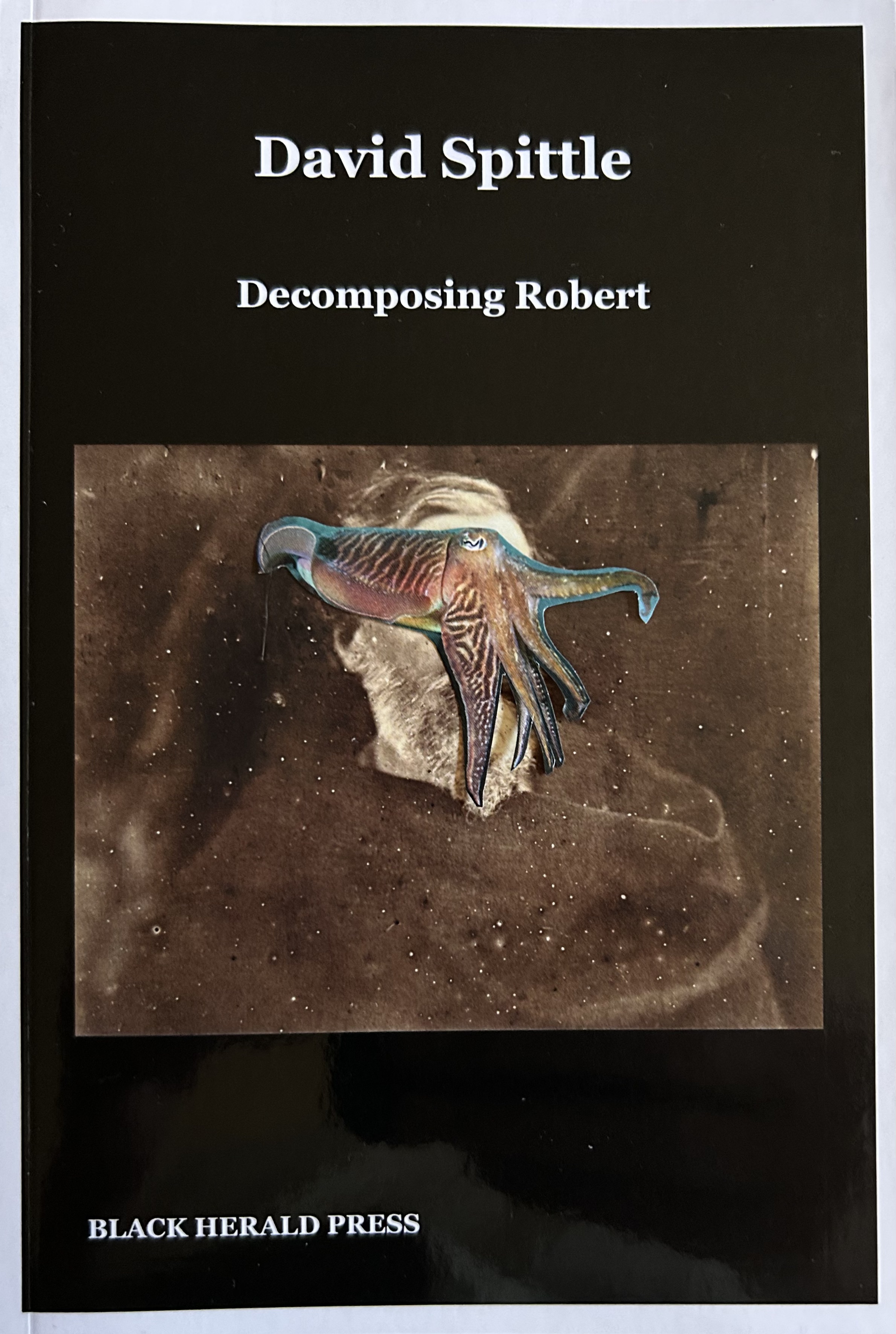
Resuming after 14 months pretty much as though nothing had happened is how this works, so here’s another ‘just a sentence’ that, thanks to enthusiasm/inability to to think succinctly, got way out of hand and turned into a mini-review, or, in this case, into an Afterword for the book . Getting out of hand, skin and indeed muscle, memory, and fatty tissue, however, is very much the agenda with Dave Spittle’s long poem on in and after Browning. For that reason, there is another mutated version of this review here.
*
When my reading list for first year at university included (among much else), The Ring and the Book, I experienced two contrary sensations: a quailing – would it all be like this? And a quivering urge to be among the blank verse/and never to emerge. There is in all of us – thankfully to varying degrees – the temptation to betray this life in favour of the afterlife that is reading, and something of the same sensation overwhelms the reader a few hundred lines into David Spittle‘s latest maximal opus.
We are, we realise, much as David Bowie exclaims in Twin Peaks, living inside the text: you, me, Browning, EBB, David (Spittle, though let’s not exclude Bowie), a doctor, Harrison Ford, and, of course, Agent Dale Cooper. ‘Who hears anyone above the meter,’ or amid ‘the mud-stuck chess’ of poems, letters, fantasias, reflections, digressions, someone’s memories (and Memory’s someones)?
Text emerges from text; text devours text; dust dines on lust. The corpses of bookworms swill; the dead centipedes invent new punctuation – ‘The work: remains.’ The glorious truth this circles around is that the only recording of Browning is of Browning forgetting his own poem. As the text breaks down, there are shades of Michael McClure reading to the lions, except the lions appear to be on the other side of the bars, dressed as condottiere in half armour: ‘Robert and Elizabeth. nutrition in the slidings of form. to love like that through letters.’ While its protagonists lack a pulse, the verse itself has one that is indeed audible above and beyond the meter.
This is as much a meditation on reading poetry as on reading Browning: what has happened to that space beyond the short sharp lyric, it asks us, beyond the slim, single-themed volume, the milling space Nietzsche described as occurring between two thoughts, where Browning somehow persists, undead, under-read?
Disguise it as we might in the new fustian of relatability, there comes a moment when we all realise, as Spittle posits towards the dissolution of his final pages – while contemplating both the Deadness and the Whiteness of the Male, beneath the ‘gastric sky’ and with the cancelling line of sous rature for our horizon – that reading has itself become fetishised, a certain good in itself, regardless, instead, or in dread of content, and we are therefore the corpse-eaters in denial, with our napkins secured to our insectoid thoraces, slurrying our words in the anxiety of effluence: tuck in, tuck in! Get stuck in! Get stuck.
Two Tongues, Claudine Toutoungi (Carcanet), £10.99 – NB currently 10% discount on site
Another ‘brief sentence’ that got away from me – perhaps because I’m always very impressed by poets who’ve worked out – as Claudine Toutoungi has in just two collections – what their angle of approach to their subject matter is. Especially when it is, as here, playful and so linguistically and imagistically inventive without surrendering seriousness.
*
Claudine Toutoungi’s previous book, Smoothie, was one of the most imaginatively various and subtly engaging debuts of 2017. The punning title of her latest book, Two Tongues, takes matters to another level by exploring a perennial condition of inbetween-ness suggested by her own name. In the rueful, witty poem ‘Amendment’, through listing all the ways others mispronounce that name, she gains access to a soup of synonyms, a hotchpotch of homonyms and heteronyms, that seems to spill out across these delightedly and delightfully restless poems.
She proceeds to find linguistic interzones and perceptual anomalies everywhere from art galleries and railway platforms in movies, to the 5th Arrondissement, where a benthic snailfish is glimpsed in a bistro named after one of the Malatestas – whether the poet-condottiere or the anarchist we never quite learn.
The two tongues are always more than two – French and Arabic recur, but all the offshoots of identity that diglossia offers are explored here in a poetry of singularly energetic grace. She takes particular pleasure in the listing of many disparate things and in finding them not separate, just differently intimate, revelling in the strange measuring scale of her recurring ‘Acuity Index’ – and indeed in mushroom nomenclature.
As fascinated by what others want us to be (and why) as by what we want to be ourselves, the collection offers a pell mell progression through possible selves that never forgets the assumptions and impositions placed on those whose culture, language, and imagination is not singular. In one poem, where an alien abduction is hallucinated by an ‘endurance artist’, the visitors have ‘seventeen words for race’, and throughout, even when with those we love, we never feel far from another ‘hot coffee baptism’. Things recurrently appear as they are in the Pink Panther movies, where, as Toutoungi apprehensively notes, Herbert Lom’s thumb is never far from that cigar guillotine.
These are poems full of zugzwangery, suffocating marmots, lost umlauts, invasive and possibly universal Hungarians, and the amazing donkey libraries of Colombia: in short, they evoke and embody what she calls ‘the full twistiness’, but which you might know of instead as ‘reality’.
Next near-subliminal Facebook flashcard was from Depths of Lockdown. This was the same image I’d picked out to illustrate a point about Creative Procrastination in my piece for NCLA’s New Defences of Poetry, a website-that-shoulda-been-a-book edited by David O’Hanlon-Alexandra, so the first piece is the Effbok para, and the second is that section from my essay, which was subtitled ‘The Unfixed Collage‘. It seems especially appropriate to reproduce these now, as the subject of collage was hanami: observing the cherry and other blossoms which are so briefly with us at this point.
1
This image was of some small significance to me then and still is, because it was the one in a long line of casual collages when I realised that collaging, and the general playfulness-without-purpose it signifies for me, was an important technique in just keeping going. And that just keeping going in a creative sense was at that time as important as in any of the other senses we were attempting to do so.
I’d been looking for a way of understanding the link between two concepts: Creative Procrastination, and the Ephemeral – and, duh, suddenly it dawned on me this was it. Collage gets you down off the high horse of language (if that’s your particular high horse), while responding to the provisional materials supplied to you by the newspapers and magazines you interact with daily grounds you in the quotidian.
You reach out to whatever those images refer to, and you reach in to whatever in you processes and blends them. The almost-wordlessness helps, because the words of others begin to stand out and reform themselves with the same compelling a-logic as language in dreams, and, when the occasional phrase forms in your head, it seems almost as if it too has come from somewhere else.
And so you are carried through the days at the speed of a pair of scissors, snipping in order to unite as though reuniting the parts of something completely unimportant and meaningless, but, still, something you can nearly, almost, see.
2
I’ve been happily filling those weekends I haven’t been Wurking-with-a-capital-Urk with clueless n glueless collage. That being: images torn and snipped from recent newspapers and magazines put together with half an eye and half a mind, so that elements of the unconscious might gather close and peer out of them, the resulting image being photoed rather than fixed.
This unfixity seems to have been key in releasing a certain dreaming aspect, though of course these things can never be completely unfiltered, nonetheless the wish that image could drift into juxtaposition with image and text somehow reassemble itself has become more and more “important”. Though, equally of course, part of the point here is that these are unimportant.
In other words these are instances of The Ephemeral as one use of social media, i.e. not Publication with a capital P, but publication with a petit pois. Playful not point-filled. Sharing rather than declaring. Not harkening to the hierarchical.
After working pretty solidly from January 2020 to February 2021, I went on research leave. And creatively collapsed. As Wurk retreated reluctantly, and research proper began, I gradually found my way back to research improper – that is, the Ephemeral.
I’d contend that this sort of daily practice is what keeps things going between poems, and in the longer spaces between projects. That ‘proper’ writing and imagining may well go on any old how it can down in the Blue Crevasse, and not very much of that is shared – indeed most is shredded:
I heard the telephone ringing deep Down in a blue crevasse. I did not answer it and could Hardly bear to pass.
(Graham ii.19-22)
But this stuff and nonsense too plays its part, particularly the nonsense. Because attention to ephemera is, for me, the miss-it-at-your-peril link between collage, haiku, political or occasional poetry, and that ongoing practice. It’s slightly more than practice, the Couch to 5K app replayed as Collage to 5 dreams per day, and so talking about it is a bit like, finally, gluing things down – something I’m not sure about doing, but am sure at least that it is right to be ambivalent about.
Next up in the ‘Just give us a sentence – please! Stop! Please – just a sentence will do! Please just stop!’-that-turned-into-a-review-anyway category is this appraisal of Paul Summer’s new book, published May 1st.
In billy casper’s tears major modes and themes work dynamically with each other, setting keening elegy for individuals against a backdrop of lament for those generations dealing with hardship and neglect in the coastal and estuarial North-East.
Just as keenly, it evokes the changeable nuances and, sometimes, blunt unsubtleties of the environment, both weather and wildlife. And just as vividly, it reaches back into industrial and maritime history, drawing subtly on the eschatological force of Norse myth.
Its sharp and tender exchanges with its subjects therefore seem underpinned with a visionary aim: how may verse counter the distant indifference of power? This sense of purpose creates a second driving synergy between musicality and anger.
The poetry, in short, is in the fury, but stemming from a place where craft is renewed as much by compassion as by long-held conviction – hence both the eloquence of the demand for redress and the seemingly effortless directness which which these poems touch our emotional core.
As the references to Blake and Brecht imply, rather than mere feel-good right-thinkingness, there is here a righteous anguish which singles this work out as radical, renewing, and indispensable.
Continuing the theme of images randomly thrown up by Facebook that then vanish before I’ve finished my usual arduous Working-Out-Of-Thinks, this was from the day of the Russian invasion back in February. The image itself was more than a decade old at the time, so this definitely qualified as an instance of Xenochronicity.
These texts, about images forgotten by me but ‘remembered’ by an algorithm, fall into an aligned category I think of as The Provisional – essentially what you make of such coincidences, and how they operate as a type of stochastic research, in which you allow chance to determine what it is you talk about, whether as a subject or as the materials or reading supporting that subject.
*
‘On this day of all days, Effbok randomly throws up an image of a Soviet tank crew having a picnic, quite possibly on the Ukrainian border, just during the Second World War…
This image was from Gladston’s in North Shields, which shut in 2016, but which sold hardware – and model airplanes, etc. This was back when the realm of model warriors was fixated on historic conflict, and not, as model shops now are, on the fighting taking place in gaming dimensions.
Something about the slightly absurd pastoral aspect of this scene still gives me pause. I wonder, in the face of new tank-related uncertainties, how much of that prior modelling impulse was accuracy-fixated (reproducing the authentic details of actual machines and uniforms), and how much it was related to controlling the chaotic violence such machines and uniforms produce?
Was the possibility that you could miniaturise, freeze, and thus stabilise such potentially terrible matters important, or were modellers just a bunch of General Jumbos?
The apparent innocence of this moment extended the modelled cosmos for me to include the concept of, not peace, but certainly non-fighting – military boredom. Might this extend to hospital scenes, or depictions of the shell-shocked? Is there a model of members of a highland regiment digging a latrine in the Crimea?
Could this weird nostalgia, which seems to lie at the heart of Brexit and other post-imperial fantasies, in some sense depict ‘actual nostalgia’ – a 19th C response to military trauma? Might there be a model of Liz Truss in a tank, given that she herself was participating in the construction of an image modelled on Margaret Thatcher?
Could modelling extend to the terrified families crouched under their tables in present or indeed yet-to-come conflicts? Will there some day be a model of child soldiers sharing cans of soda, thus bringing the whole thing full circle?’
Here’s another enthusiastic response to being asked to read a book, this time one by the very fine Lindsay MacGregor, who first studied then taught at Dundee Uni, who hosts the Ladybank Platform readings, is part of StAnza’s constellation of enabling and participating poets, and whose pamphlet, The Weepers, came out in 2015 from Calder Wood Press.
I should’ve posted this when Lindsay’s book was launched a few days ago, but on that occasion was perfecting my slack-jawed yokel impersonation. (Or was it Fish Mime Night? – if only I would write things down in my diary as opposed to brandishing it at the Moon and yelling ‘See? See?!’) In other words, whenever I start thinking about my own writing, Time starts whipping past while cackling.
(The following is also available on Peter McCarey’s Molecular Press website, which is well worth the rummage through, so this is in the spirit of belting and bracery. Though I can’t at present work out how you buy something on that site, so perhaps this would be of use?)
Desperate Fishwives (Molecular Press 2022)
Lindsay MacGregor’s landscapes both precede and extend the notion of Scottishness: on the one hand into the archaeo- and geological, and on the other into the post-human. These are poems which not only conjecture that ‘The dead carry the day between two still lochs’, but investigate how. They are layered, subtle, and subversive, full of inquiring birdlife (whaups, cormorants, wrens, craws, dippers, snipe, and – why not? – penguins), herbs with an agenda (often types of bane), enigmatic moths, and melodic but unsettled outsiders, who might just be the place’s most honest inhabitants.
Figures like MacDiarmid and Joan Eardley are seen altogether slant, parenthood and childhood carefully consider and sometimes swop roles, the overlooked and under-considered are given voices that they may be heard – although with only the justice of her very fine ear by way of recompense. Phrases, rhymes, place names, are turned and tumbled till shiny and shaken loose from our over-familiarity. The lullaby leaves us wide awake, as does the warning: ‘Don’t tamper with the harebells’ – or the hare. The numinous, too often reached for as a signal of authenticity, Celtic or otherwise, must wait its turn amid the ruins and the VR; grief will be heard before grievance in marvellously constructed and (where MacGregor plays with variation) reconstructed verse, by turns playful, melancholy, and furious.
Yes, the fishwives are desperate, but, unlike those who hold them in such disregard, and very like this remarkable and engrossing collection, they have an exact knowledge of their own worth. You might find this book handy yourself when weighing things up, should you need to do so not in general, but in precise, startling detail.
This review of a book of essays exploring the range of forms possible within creative critical thinking was supposed to appear in a briefer form sometime last year but, for whatever reason, did not. It acts as a sort of counter-argument to the premiss I put forward in relation to Why I Write Poetry – that this kind of essay was primarily an extra-academic form. Here the Creative Writing unit at Dundee University have taken the sensible approach of setting aside such assumptions about the borders of the campus, with the result that they have situated the academy in a dynamic and engaging manner within that broader cultural discussion.
If I were capable of bringing my self-contradictory views together more coherently, I’d vote for the discipline of Creative Writing to be not exactly at but more by the centre of such debates, ie to exist in an eccentric manner in relation to them, working with the writing community, and writers and publishers in the community, as one element in three. In general at present it still prefers to ‘validate’ writers through its conferral of degrees. This is partly because such degrees help validate the credentials of the institution itself in terms of its capacity for ‘outreach’ – a term which reinforces the very division it supposes itself to be stretching across.
But what Imagined Spaces suggests and goes some way toward demonstrating is that there is a further space where university and writing community and the wider world (with such writers in it) all overlap, but that this is beyond the ‘jurisdiction’ of any one of those bodies (its capacity to state what is or is not ‘the law’) – that is what makes it both fraught and joyous, a space that some would police jealously precisely because it is such a pleasure to join: all you have to do is try and set aside everything you suppose is true about art, fail to do so, try again, and keep right on failing…
*
Imagined Spaces, ed. Gail Low and Kirsty Gunn (The Voyage Out, 2020), 224pp, £14.99
As Creative Writing settles into its fifth decade in a university near you, issues about how and whether it can be taught now seem like the province of shouty naw-it-alls and yestermen. Even the matter of practice-based research appears settled, as institutions realise the status of creative publications.
The attempt to measure the ‘impact’ of these outputs, however, is still largely conducted in terms which reflect academic monographs and scholarly editions. But in the last decade, not-entirely-academic writers have been considering how to write in and to the academy, deploying a range of discourses which enable staff and students to address the distinct nature of creative research, thinking about process and influence as much as theory and citation.
Self-reflexive commentaries, bridging chapters, creative criticism – all these approach the condition of the essay. That, then, is what is being explored and celebrated in this anthology from Dundee University’s enterprising press, The Voyage Out.
Just as there were assumptions about teaching, then research, then impact, so too there are expectations about the essay. Any book that would embody this discipline must surely contain: allusions to Montaigne; an essay that sets aside its discourse to speak personally (Montaigne-ishly), and thereby shed new light on that discourse; an essay about the essay; an essay that just happens to be about this very essay, i.e. itself. As Philip Lopate warns in his entertaining taxonomy of the form, ‘I would just like to caution that we essayists not take too seriously our own defensive propaganda, or adopt too smugly [a] self-approving, narcissistic, idealising portrait of the form.’
While Imagined Spaces includes examples of all the above, in most cases it moves beyond idealisation into a formally exciting demonstration of the contemporary essay’s merits. Further, it interweaves individual pieces with a series of intriguing dialogues, sometimes maintaining, sometimes merging their authors’ identities (as in the lively introduction).
These include dialogues on home, depression, and drawing; a fascinating exploration of what Glenn Gould termed ‘The Idea of North’ by Orkney-based Duncan MacLean and the writer and naturalist Kenny Taylor; and a discussion of the influence of civic thinker Patrick Geddes between architectural theorist Lorens Holm and artist Paul Noble. These amount to an argument for the range of the democratic dialogue (as opposed to the hierarchical interview).
To return to Lopate’s constantly expanding definition of the essay, it is interesting to note he stumbles over ‘the hybrid cross-breeding of non-fiction and fiction’, a category one might have thought hard to distinguish from the essay’s use of the apparently personal. But, as he says, ‘The contract between essayist and reader is based partly on the assumption that the essayist is levelling with us…’.
This is the criteria which marks out two pieces which exemplify what the essay is capable of. One is a exploration by Susan Nickalls of the thinking behind Kengo Kuma’s V&A building on Dundee’s shorefront; the other, a study of mortality by Meaghan Delahunt. Noticeably, these draw on spiritual practice – Zen shaping Kuma’s aesthetic, and Tibetan Buddhism having a strong bearing on Delahunt’s meditative approach to her mother’s death and her own mortality.
Nickalls pinpoints Kuma’s fascination with Rennie Mackintosh as key to his engagement with ma or negative space in the museum, where the Oak Room locates an interior in an interior, thus underscoring his comment, ‘My stance in every field has been to be sceptical of any logic that does not have gaps.’
Similarly, Delahunt is drawn to a point of weakness in her sense of self. Through losing her parents and then her mobility, her identity as a writer feels like it’s being taken from her. Crucially, she finds a way to engage us with this loss, beginning with the intellectual realisation that ‘Major life events and relationships are bardo states. So too are the shifts of circumstance throughout a life – beginnings and ending, accidents, and lucky breaks.’
By keeping to her end of the contract as Lopate describes it, she carries us through crisis to a scene in which, having set aside her need to be a writer, Delahunt becomes instead scribe in a hospice to a mother and daughter undergoing their own moment of extremis:
‘In that moment S is not dying and leaving this child and her older children behind. In that moment, we are all deep in the bardo of life and creating something beautiful and transient, something which has meaning.’
There, it would seem, is a definition of the essay we might try and work with.
The interiorising impulse is a normal part of most writers’ cycle of composition and publication, but it became stronger for me with my father’s death, after which I spent a couple of years darting off to any far-off place that invited me, blogging re the Dundee Makarship but not editing the posts into anything, and stringing tweets into absurd Informationist tales, which, probably sensibly, I’ve not really looked at since. Of course for a lot of this material the internet is a sufficient if rickety platform, and if stuff falls off into unvisited oblivion that’s fine too – I’ve been failing to finish novels in this manner for years, and they don’t even have to get that far.
My failure to keep posting even to this modest extent kicked in when my mother had a stroke a few years ago – I had the next item good to go, but then I wanted to say something about that long night when her life hung in the balance. Mebbe that would position it – or at least enable me to regroup? But Uni work kicked back in, a degree of caring joined the mix, and… Pause.
Or rather a slowing down to the glacial pace fewer and fewer glaciers are in a position to maintain, the near-invisible rate at which plants grow, if not in a warm and hospitable climate. A lot of this is down to a failure of the work/life balance where the ‘work’ isn’t even the teaching/research part, it’s just the admin that goes into supporting the internal workings of the institution as business – the frenzied work-like facsimile of work – while the life bit therefore has to include the ‘Life Work’, just trying not to bother anyone, thank you very much. There’s no actual balancing going on here, just the occasional offer of a remote wellness seminar.
Despite which, a lot of stuff has been written, requested of others, shared, and published, if not quite promoted as I might have done previously. But it’s signal at least to me that this pause preceded the Pandemic. That first Lockdown was, in its terrifying way, a bittersweet, continually fraught opportunity to regroup not just as individuals but, where possible, in the family and social units that meant most to us. Our daughter came home at its outset and we lived together almost as we might have done in previous generations, without that centrifugal force flinging the young to far away universities and jobs and London.
But to the extent that Lockdown opened up a weird creative space amid the very slow playing universal panic, for me it opened up a space in which I thought about things which were already not happening.
Meanwhile, just the poetry of facts, MacD…
The Contracted Fingers of MacDiarmid Conclude Their Report to the Recording Angel
If the spells of forgotten Scots formed one powerful discourse, and we’ve already noted bardic learning shading into academic bibliography as a second, a third is modern media – in poems like ‘The Wreck of the Swan’ we find reportage in the form of doomed radio messages: ‘VALKYRIE calling all trawlers…Old Feathery’s got us at last…’, or, in ‘The World of Words’, advertising speak: ‘Easy – Quick – Sure – The exact word/You want – when you want it.’
But, while the late poetry is famously focussed on ‘the poetry of facts’, it’s important to distinguish that his actual focus is more on a versification of factoids. Our fourth tree is one such instance, and leaves Graves behind. Describing the transcendent consciousness that has been his focus since ‘A Moment in Eternity,’ MacDiarmid writes
Apart from a handful of scientists and poets
Hardly anyone is aware of it yet.
(A society of people without a voice for the consciousness
That is slowly growing within them)
Nevertheless everywhere among the great masses of mankind
With every hour it is growing and emerging.
Like a mango tree under a cloth,
Stirring the dull cloth,
Sending out tentacles…
That hopeful-sounding combination, ‘scientists and poets’, indicates the sort of grafting that is going on here. It is the same self-validating tone MacDiarmid strikes when, in ‘The Seamless Garment’, he offers to explain Leninism to a cousin working in a Langholm mill: ‘Look, Wullie, here is his secret noo/In a way I can share it wi’ you.’ That he promptly goes on to compare Lenin not just to weaving but to that famous Marxist Rilke suggests that he is trying to weave himself into a dominant narrative that might find poetry superfluous. So too here, where what sounds tonally like a newsreel mingles with that insulting image of his fellow humans as ‘dull cloth’, while the mango’s hidden movements recall the Drunk Man’s obeisance to ‘The Octopus Creation’:
I am the candelabra, and burn
My endless candles to an Unkent God.
I am the mind and meanin’ o’ the octopus
That thraws its empty airms through a’ th’Inane.
That self-aggrandising yet insecure ambivalence toward his fellows, be they family or countrymen or an indistinguishable part of ‘the vast majority’, is perhaps the heaviest charge we can lay against MacDiarmid. His is a Scotland that isn’t enormously interested in the Scottish people, one that would rather contemplate the bog-myrtle, and number the streaks on the harebells. He is so eager to dispense with the bath water of the populist Kailyaird and the likes of DC Thomson’s People’s Friend, that he throws oot the bairnie of a genuinely radical nineteenth century working class poetry, based in the newspapers as set out in the studies of William Donaldson and, more recently, Kirstie Blair and Erin Farley. Ironically, he then establishes in the 1920s a newspaper, The Scots Nation, that he largely writes and quite possibly reads by himself.
Our final tree is the Kandym, or Calligonum Laucocladum, from the family Polygonaceae. It grows across Central Asia as far as Xinjiang in Western China, where another regime which MacDiarmid was keen to align himself with is currently repressing the Uyghurs to the point of genocide.
The tumbleweed-like properties of this tree’s seed appeal to him, and the symbolism of this survivor in the Taklamakan desert is not hard to seek:
…sometimes the sand waves are so big
They bury the kandym nevertheless.
Then a race begins – the dune grows and the plant grows.
The dune grows fast but the plant grows faster still
And by the time the sand dune has attained its final height
The plant is found to have outstripped it.
The poem ends ‘My songs are kandym in the Waste Land’ where the capitals emphasise the parallel and yet the contrast with Eliot: while The Waste Land depicts a shattered world of shored-up cultural fragments, the desert is kandym’s natural environment. Mid-century Scotland may well be too peaceful for him, but he has declared it a desert. His fragments, moreover, are drawn not exactly from high culture but newspapers, periodicals, secondary sources – all varieties of the ephemeral. Late “Hugh MacDiarmid” is a one man Google, searching before computers for something he can only define as ‘almost everything he has found so far’.
We don’t (yet) know where he got hold of this fact about the resonantly-named kandym, but we can see that, in absorbing it into his poetry, he is struggling against the loss of everything we read and then let go of: other people’s facts and phrases are being heaped up against oblivion.
Late poems like this reveal that, from the outset, MacDiarmid’s work exists in a quantum state of allusiveness, a condition of uncertainty where we are perpetually having to decide whether it is or is not written by him and considering what we might think about where it ‘really’ comes from.
The final twist to MacDiarmid’s solipsism is not only that all these texts end up sounding like – and appearing to be about – him, but that his metaphors end up not only being metaphors for poetry but, specifically, for his poetry. It’s not for nothing that another long late poem is called The Kind of Poetry I Want, and yet there is still a shock in realising that a text which frames itself as being ‘about’ the thing is actually the thing itself: this is exactly the kind of poetry he wants.
The five fingers of Baal do not quite contract into the Communist salute, but they reveal something of MacDiarmid’s capacity for dexterity to the point of prestidigitation – as long as we take him with a cromag’s-fu of salt. In ‘The Glass of Pure Water’, MacDiarmid describes an angel reporting on a hundred years of history, but not verbally. Instead he enjoins us to
Look at the ridge of skin between your thumb and forefinger.
Look at the delicate lines on it and how they change
– How many different things they can express –
As you move out or close in your forefinger and thumb.
…the angel’s report on human life
Was the subtlest movement – just like that – and no more…
This image, with its recollection of Keats’s late fragment ‘This Living Hand’, circumjacks or corresponds to what his work is attempting to do at every point, which is – whether through light-fingered collage or dictionary-dredging, epater-ing the nearest bourgeois or dodgy fact-finding – to find the perfect summative and ultimately lyrical gesture.
I started with a still from a film so I’ll finish with another. In Margaret Tait’s 1964 portrait of MacDiarmid, there is a short sequence of him capering through the streets of Edinburgh. He is tightrope-walking along the kerb or louping up onto low walls wi a droll fag in his mooth, a funambulist without a tightrope or at least not one anyone else can see, a septuagenarian schoolboy, pairt-Chaplin, pairt-Chic Murray, hauf-Hugh, hauf-Chris – all Makar.
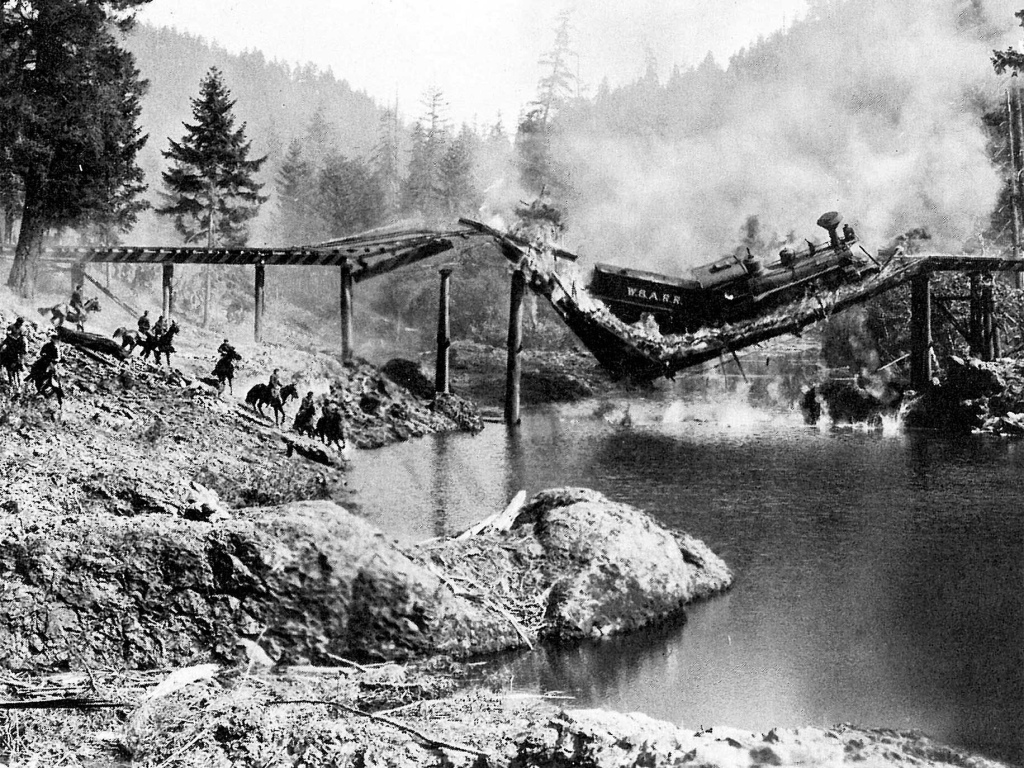
So complete is the lacuna created by the pandemic that, when it comes to the microcosm of poetry, entire books were swallowed up by it like Keaton’s famous shot in The General of the titular train steaming off the blown-up bridge. ‘Are you sure you want to use a, uh, real train, Mr Keaton?’ ‘Sure, it’ll look real-er that way.’
(This is my ever-so subtle way of saying, ‘Dear Reader, my book was that wreck – though I associate it more with the Tay Bridge Disaster, but am trying to keep it light.’)
Even less important, except to folk missing out on the small bump of publicity thus provided, is me forgetting to share, as was once my wont, a review a few months after it has come out. In this case it’s from The Poetry Review all the way back in the winter of 2019, so I should’ve posted it after the Spring issue, ie around March/April 2020…
There’s something joyous in staring back in this way through the difficult atmospheric conditions of events, and the especially small stour of contemporaneity. Look, directly under the still-descending train – isn’t that the Angel of History, trying to row a boat while facing the wrong way round? Is that river even tidal?
But all the awards have already been awarded, new stars are being selected for the night sky quarterly – in some cases, subsequent books have appeared by these very authors – yet here they are, these three books, just as fascinating, just as re-readable…
*
Miriam Gamble, What Planet, Bloodaxe, £9.95 ISBN 9781780734840; Kei Miller, in nearby bushes, Carcanet, £9.99 ISBN 9781784108458; Helen Tookey, City of Departures, Carcanet, £9.99 ISBN 9781784107598
These three collections concern themselves in their contrasting, yet equally innovative, ways with the tensions between our imaginative apprehension of place and the often-resistant realities of places themselves.
In Kei Miller’s case, perceptions of Jamaica play out wittily through dialect and toponym, and are set against violent circumstances, explored with a profound awareness of their cultural and historic causes.
For Helen Tookey, place becomes a series of intense encounters with the territories of European artists, in which their settings or personalities – and the poet’s – mingle or erode.
Miriam Gamble’s poetry contrasts themes of home and visitation with an unsettling control of tone and imagery, locating meaning in sudden symbolic gestures of freedom, or perspectival shifts.
– One such occurs in the last line of ‘Kitten’, where uncertain demarcations of memory (“In what you remember as the dark but/can’t have been given it was summer”) contrast with a glimpse of the speaker as if seen by the kitten in its carry box: “Your face against the grid, blunt as a shark”.
Inanimate objects are granted their own near-autonomy, sometimes putting the characters in these poems in their place. In “Girl with Book and Rubber Band”, the girl has attached a book “to a string of rubber bands” and treats it like a yoyo, “sending out and reeling [it] in … on a rubber leash” causing traffic to come to a standstill and her witnesses to decide that, “we like the cut of her jib more than anything”.
Self-reflexiveness creeps in as the girl and her friend achieve a joyous liberation, “Their shoes…nowhere to be seen.” – This could be read as referring to this book, in which several poems are produced in “collaborative conversation” with another poet, focussing on the 2014 Scottish ‘IndyRef’.
Such elasticity extends to the syntactic flow of these poems, as in the anaphoric incantation of ‘In the annum’, which settles itself in a time ‘before’: “In the annum of the water bomb…of the girl’s shoe with/a key in the heel…In the annum that preceded/American Beauty…”
However, these apparent innocences are set against a sense of impending threat summed up in the first poem’s intimate dread of “a provisional touching your father’s hair” (‘The Landing Window Is Unspeakable’), and embodied in the later elegies for the poet’s mother.
The mating dance of the bird of paradise or Parotia seems to embody Gamble’s sense of the unchancy nature of liberty as something both compulsive and absurd: “Say/that the brown bird looking on gives audience/only in the sense that Commodus gives audience”.
The echo of ‘parody’ here points equally to parable or satire: no sooner is the bird seen as a “defrocked cleric” than its mate is being directed as though in a strange farce: “Under the light of a supermoon/let the watcher make haste to the village hall” (Parotia Displaying in a Forest Clearing’).
These elements come together in the sestina, ‘Betty Staff’s’, in which a grandmother presides over a dancehall despite impending social changes and the spectre of domestic abuse:
more than once he will knock her to the floor, and free of breath.
But to the jewel-clad notion of the post-war 1950s,
Betty will play the mother octopus – Lengthen your neck. Die nacht ist wunderbar –
Kei Miller’s poetry is constantly locating itself while dislocating the reader’s sense of a stable ground from which to consider it. Its setting, Jamaica, is sure enough, but as the cartographer of his previous collection found, Jamaica is itself a place of ‘immappancy’ in which our sense of place is reconsidered and renewed.
That critique continues here – ‘here’ being both island and page – in the transitions of what he calls the understory, where epical matters such as arms and the language in which we speak of them shift meanings:
Here that cannot be held
by the small arms of language.
Here that cannot be held
By the small arms of English.
Here that cannot be held by the English.
(‘Here Where Blossoms the Night’)
The very flora and fauna – those perpetually ‘nearby’ bushes, an escaped herd of reindeer, “without snow”(‘Here Where Run the Wild Deer’) – and an underlying geological instability, all contribute to this perpetual revision of how we believe ourselves to be somewhere, glimpsing through this ‘the quiet that is not quiet/this peace that is not peace’ (‘Hush’).
In the central section, ‘Sometimes I Consider the Names of Places’, the etymologies of naming and the strategies of recycling names create doubled places and erase existing ones, “as if this world was not enough”.
This imposition of naming pushes Miller’s attention towards the unnamed in ‘So What Will We Call the Thing Between Places’:
Like hiking up a mountain – that thing between one village and the next, between the long sit downs, the stretch between the stretch? What do you call it – that interruption of miles that might smell of Eucalyptus, that limbo of land…
Desire, transgressions, and imaginative possibilities all cluster in such ambivalent zones which, in the book’s titular final section, contain murder. Here page and the body of the murdered woman seem to double each other, as newspaper accounts are repeatedly sifted for implicit text, picked out in bold, while an extraordinary posthumous narrative depicts the murder victim:
Already the worms are rising, pulling towards you, towards the thing you once considered you: the body. You had a heart; it stopped. Then things began to happen. (III)
This “useless energy of ghosts” ((XI.I) is redirected with great tenderness into an vision of the tension between our deep need for security and the violent insecurity of our needs, and how this plays out across gender, history, and race. The book ends with the reiteration of a prayer: “Wake up in another book. On a kinder page.”(XIV)
Helen Tookey’s book similarly presents itself as being written into a landscape, often European, sometimes Northern, and this landscape too is edited by memory and imagination. Spaces can not only change, but be erased:
When we reached the sea-front I was at a loss. The front as I had known it – the busy road with its hotels and coloured lights, the children’s boating lake with its due and yellow paddle-boats – was no longer there.
(’Front’)
Rational explanations are off-set by hints of the unheimlich: ‘But it hasn’t been like that for a very long time, they said. Not since before’. Wrecks go missing, time pops itself out of joint, the scale of things seems wrong, as in one of several poems about the painter Leonora Carrington:
You were the smallest, but now you’ve grown bigger
so you pick them up between thumb and forefinger
– mother, father, brother, brother –
and fix them all in the painting, whistling
Hotels, seemingly empty; civic spaces where rhododendrons conspire with the signage; landscapes with artists fading into them: the book combines poems and prose poems in a compelling zone of stark atmospheres and richly observed interiors, “As though the ordinary business of being a hotel were the discourse, which has suddenly been abandoned, the notional hotel turning instead to address us.” (‘Hotel Apostrophe’)
These spaces become the set for found voices – the letters of Paul Celan and Ingeborg Bachmann in ‘What Can We Still Do’ echoing the voice of Vivienne Eliot in The Waste Land. In the remarkable essayistic final section, ‘Skizzen/Sketches’, the roles of the artists and writers is considered not, as might be imagined, in terms of their cultural authority, but rather as genii locorum.
Anita Rees for instance is described as merging with the island in North Frisia where she commits suicide: “She abstracted herself, eroded herself, erased herself, walked further and further into the island until she didn’t come out.”
Paradoxically, these erasures become types of transfiguration, ecstasies which affirm our at-homeness even as we depart. This is enacted in poem after poem – the girl “who chooses not to speak” but to make origami birds, the absent Louise imagined “pulling a sled across miles of snow, skirting the pinewoods”. Finally, in ‘Quend-Plage-les-Pins’, place is stripped of every human attribute, “the pines/can stay, and the dunes, with their strange/tenacious grass…” leaving only our ability to imagine it: “It wouldn’t need/a name. It wouldn’t need us.”





 gairnet provides: press of blll